The Importance of Water

Here is a short story for you. You may have seen something like this before. 'The Importance of Water' was one of the most loved short stories from my 2025 Collection: 'Read My Shorts'.
This version is condensed from the original. I hope, if you've read the previous version, that you still find the condensed story equally impactful. I'd love to hear what you think.

The Importance of Water.
The twins begin their pleading as soon as the front door clicks shut behind me. It’s a ritual now, briefcase barely put down, keys still in my hand, and they’ve launched into their campaign.
‘Dad,’ Florence says, soulful eyes looking up at me, ‘We really need a pet. We’ll look after it. You won’t have to do anything. We promise’
Aubrey chimes in too, ‘A dog is best. Dogs are loyal. Cats are fine, but dogs are better. Don’t you think having a dog would be great, Dad?’
I make a show of placing my keys in the bowl on the hall table and breathe in. ‘Pets aren’t toys, they’re living things,’ I say, kneeling to hug them both, ‘They need constant care. You can’t just discard them when the novelty wears off.’
Florence folds her arms. ‘We know Dad, we aren’t babies.’
‘Perhaps a holographic pet would be good. That way you could get used to the routine of looking after one before you make the commitment’. My words sound lame even to me as they come out. ‘What does your mother say about getting a pet?’
Aubrey shrugs. ‘Mum says it’s up to you.’
Of course it is. Clare grew up surrounded by animals. The family’s farm left its imprint, a kind of muscle memory of dawn chores, feeding, and cleaning up after stock. Clare told the twins stories with a mystic melancholy. The names of old dogs, the personalities of cats, even a poddy calf she reared single-handedly. The twins couldn’t discern nostalgia from rose-coloured memory.
We spent decades wanting children. We learned to live with a careful, aching hope that finally softened into acceptance. Then our miracle. The arrival of the twins in our sixties. Florence first, with a squawk of outrage at the bright light, then Aubrey moments later, calmer and quieter. They eased into the world with their personalities already determined. Their very existence rationalised spoiling them from the moment they were born.
‘Alright,’ I concede, ‘Let’s see what I can do.’
They scatter immediately, victory whoops bouncing off the walls, already arguing the merits of dogs over cats.
*
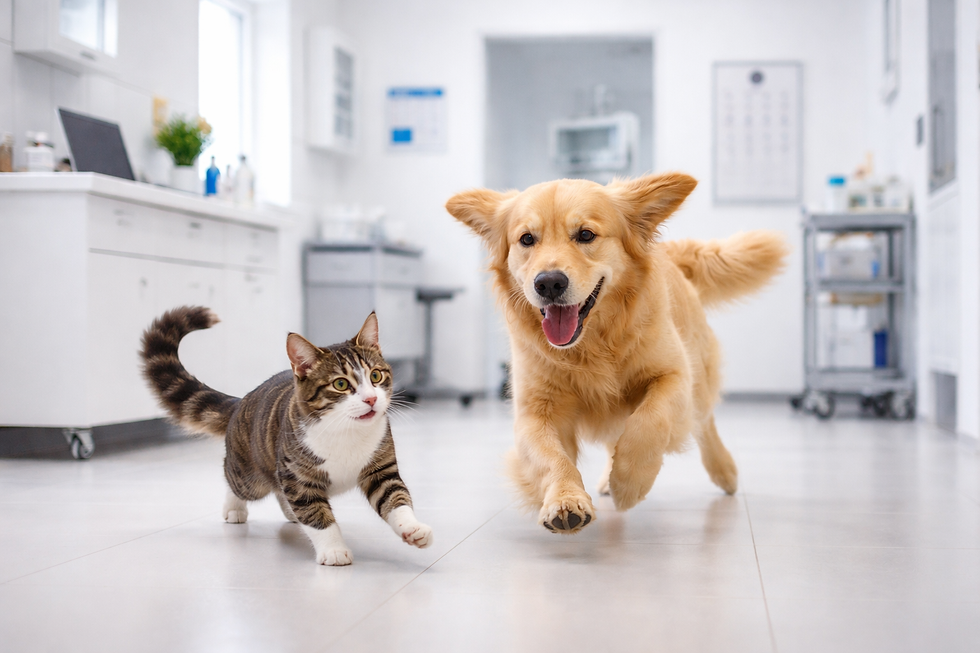
Pegasus Modern Pet Solutions sits in a neighbourhood filled with orthodontists and cosmetic surgeons. The clinic looks more surgical than retail: white lights, white floors and white walls edged in stainless steel and glass. A cathedral to modern science.
The receptionist, Enid blazoned across her chest, is stitched into her starched white uniform, polite with a smile that glows with dental artistry. ‘Good afternoon, sir. Welcome to Pegasus Pet Brokering Services. How may I help you?’
I give my name, and she scans my ID card. ‘The broker will be with you shortly. Please take a seat.’
Holograms skip across the waiting area. Dogs and cats chase each other in an idyllic game of tag, the playfulness too perfect to be real. A child reaches toward the image as if to stroke the dog, and the pixels scatter as his hand closes around nothing.
Enid escorts me down a corridor where the antiseptic air is masked by citrus. I take a seat and moments later a small animated woman races in on clicking heels. ‘Dr Bellephron,’ she says, extending a hand reluctantly. ‘Thank you for choosing Pegasus Pet Brokering Solutions. I understand you have twins. What double joy for you and your wife.’
‘Indeed. I’m here to purchase a pet for them. My twins want a dog and a cat,’ I say. ‘We’re open to your recommendation.’
Dr Bellephron’s fingers twitch toward a transponder on the desk. A hologram of a small dog appears in midair: a tangle of poodle curls spills over the eyes of a cocker spaniel. ‘A Cocker-Poo,’ she announces. ‘Hybrid vigour yields robust health. They are low-allergenic, and in our latest development they have been genetically modified to defecate only once per week. Waste removal shouldn’t be such a chore.’
She touches the transponder again and cat shimmers into view, pupils darting about the room. ‘Our cats are affectionate and yet independent. They are optimized for indoor living and have negligible aggression markers.’

‘They look terrific. I can pay now.’ I say, too quickly. ‘Whatever it costs. I’ll take them both. Today if, possible.’
The doctor’s smile falters. ‘I’m afraid delivery today is out of the question. Cats are currently available in approximately twenty-five months. Dogs, three and a half years.’
My heart suddenly plummets. ‘That’s absurd.’
‘There is declining fertility in all available breeding stock,’ she says, her voice softening. ‘We do what we can, but it is hard to fight biology.’
I think of all the times Clare and I have fought biology. Cells that refuse to proliferate under carefully manipulated environments, cultures that collapse within hours, failing to become a viable embryo.

Dr Bellephron slides a pamphlet across the table. ‘We have excellent alternatives that the children could have in the interim. A gourami is a lovely pet. They come so many different colours. All very wonderful.’
The pamphlet shows fish, insects, crustacea. ‘These are totally unacceptable,’ I hear myself say, more sharply than intended. I stand and leave the room. Sometimes staying gives despondency too much oxygen.
Back at the reception desk, Enid leans forward, invading my personal space. ‘I’m sorry that we couldn’t help, sir.’ Her tone drops to a whisper. ‘If you’re willing to pay a premium there may be other options.’ She slips a card into my palm. ‘Tell them Enid sent you.’
Three weeks of disappointed children drags on. Clare doesn’t say ‘I told you so,’ but the edges of her silence carry that intent. The card burns a hole in my pocket until, finally, I follow it through.
The address leads to station on the monorail nobody uses anymore. The precinct is a monument to days gone by, when commerce was centred on bricks and mortar retail. The building is single-story with every window barred. An oversize security door appears to be the only ingress.
I press the buzzer.
‘What you want?’ a voice grumbles over a scratchy speaker.
‘Enid sent me,’ I say, looking up and finding the camera. ‘I’d like to buy a pet.’
The door clicks open and humidity tumbles out. I step into a greenhouse where the air feels like exhaled breath. Grow lights line the ceiling above plants that look too green. The space feels lush, fertile and alive.
‘Come, come’ the voice says. ‘Close the door. Come.’
I follow the voice to where an elderly man in a lab coat awaits behind a bench. He stands but doesn’t offer his name. Maybe names are unnecessary here.
‘Enid says you want dog and cat,’ he scoffs. ‘I have better.’
He reaches into the foliage and extracts a bright green lizard whose tail coils around his forearm. ‘This is chimera,’ he says.
Before he can go on, I interrupt, ‘Look, Enid may have given you the wrong information. I’m not interested in a lizard.’
He smirks and clicks his fingers. The lizard freezes, trembles, and blooms into macaw with a blue and yellow feathers. Another click and the macaw ruffles, tilts, and shivers. A large dog tumbles onto the ground, paws trying to gain purchase on the polished concrete. The dog yelps, and leaps toward me but then, in mid-air the dog becomes a huge butterfly.
I’m transfixed. The transformation is seamless, impossible, intoxicating and definitely not a holographic trick. My mind scrambles trying to find traction: genetic switching, adaptive biology, synthetic phenotypes triggered by microenvironmental cues? None of it makes sense.

‘You like Ulysses butterfly better than dog?’ the man asks, nodding at the butterfly’s broad wings.
‘I thought the dog was going to bite me. What if it bit one of the children?’
He shakes his head, impatiently. ‘No bite. She only upset at slipping on floor. Chimera will never harm any person.’
The butterfly becomes a tortoise with another click. The tortoise blinks, slow and solemn, as if bored by the spectacle.
‘Your children must look after chimera,’ the man says. ‘Not easy, but simple. Only three rules.’ He holds up three fingers and counts on them to reinforce the rules. ‘Water. Food, Poop. Water most important. Clean water, fresh water. Always water. You must never forget water. Food and poop, you can work out. Easy’
‘What happens now…’ I begin.
He cuts me off ‘You give me two hundred seventy-five thousand dollars. You take chimera. Must remember water.’
It’s a ridiculous amount, but I have no choice. I am buying a miracle in a greenhouse. The children will be overjoyed.
He explains the water rule again and adds that the chimera will decide when it morphs to the next creature. The apparent response to his finger-clicking is something only he has mastered.
After the children’s brief disappointment bat my bringing a tortoise home, they are amazed when it turns into a cat. She’s an orange tabby that the children call Marmalade. Then, when she becomes a drooling St. Bernard, they call her Toast. The pets come in quick succession, llama, chicken, ladybird and stick insect. Then Portney, a pygmy hippo. Portney stays longer than the others.
‘I knew you’d come through. They’re wonderful, darling.’ Even Clare can’t help but be impressed.
At first, Portney seems like fun. The twins are devout caretakers. Food becomes routine. Water becomes a ceremony, and poop becomes the punchline to the end of every day.
‘Dad,’ Aubrey says, standing in the doorway with the largest eyes he can manage. ‘Portney ate all the cereal, the bread, a carrot cake and all of the lettuce Mum wanted for tonight’s dinner.’
‘And the apples, watermelon, bananas and grapefruits.’ Florence adds. ‘She’s full and hungry at the same time.’
‘Just make sure she has water,’ I remind them. It seems to stick. For a while, the water bowl is full whenever I check. The twins patrol like miniature park rangers; watering, feeding and poop-collecting.
*
I should have noticed the quiet.
I arrive home, and take a few breaths before I go inside. Then I register the hush that sits over the compound. Optimistically, I hope Portney has morphed into something less demanding. Then I hear the twins, oblivious to the silence outside.
‘Did you refill Portney’s water?’ I call into the living room.
Florence looks up, face instantly collapsing into regret. ‘We forgot,’ she says.
Aubrey looks even more concerned than his sister. ‘We were doing homework, Dad. Honest.’
I walk outside. The compound is still. I can’t find any creature. No hippo, no rabbit, no squirrel, no dog, no cat. Then I see Portney’s water bowl, tipped on its side. As I draw closer, I see it isn’t quite empty.
Laying at its centre is a very sad, grey, desiccated fish.
A gourami, crisp and devoid of life.

If you've enjoyed this short story I sure you'd enjoy my other speculative science fiction story 'Depolymerisation'. Read My Shorts: A Collection of Short Fiction is available as print or e-book. If you'd like copy and live in Perth, drop me a line before 23rd December and I'll make sure you receive it (free of postal charges) before Xmas.
Have a great Christmas.


Comments